
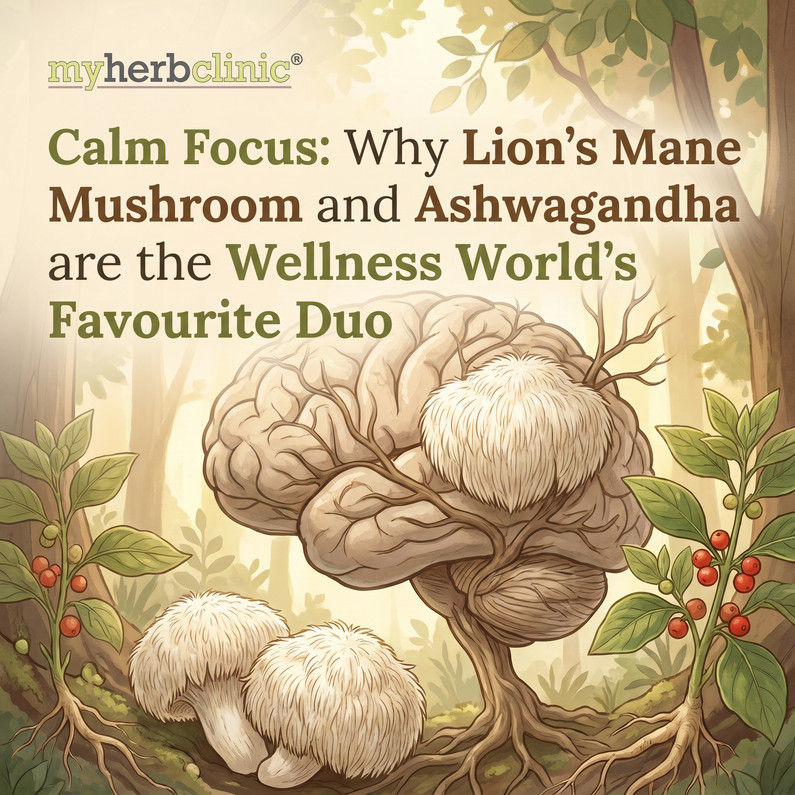
Calm Focus: Why Lion's Mane Mushroom and Ashwagandha Are the Wellness World's Favourite Duo
There's a particular kind of tiredness that has become the background hum of modern life: that "wired but worn out" feeling, where your mind is racing yet somehow foggy at the same time. You sit down to focus and your brain won't settle. You try to wind down and it won't switch off. If that sounds familiar, you're in good company, and it's exactly why two ancient herbs have quietly become one of the most talked-about combinations in natural wellness.
On one side you have Lion's Mane (Hericium erinaceus), the shaggy white mushroom long associated with clarity and focus. On the other, Ashwagandha, also known as Withania (Withania somnifera), the cornerstone adaptogen of Ayurvedic tradition. Used together, they've earned a reputation as a "calm focus" pairing, and there's some genuinely interesting science behind why that pairing makes sense.
Let's unpack what each herb actually does, why they complement one another, how to enjoy them as part of a daily ritual, and what you should know before you begin.
Meet Lion's Mane: the herb for clarity
Lion's Mane has been used for centuries in traditional Chinese medicine and is enjoyed as a culinary mushroom across East Asia. In recent years it has crossed firmly into the wellness mainstream, and for good reason: it occupies a fairly unique niche among natural brain-support botanicals.
Researchers have been drawn to two groups of compounds found in the mushroom: hericenones (in the fruiting body) and erinacines (in the mycelium). In laboratory studies, these compounds have been shown to encourage the production of nerve growth factor (NGF), a protein that helps support the growth, maintenance and survival of nerve cells. This is the mechanism most often cited to explain Lion's Mane's traditional association with memory, focus and overall brain health.
The human research is still emerging, and it's worth being honest about that. A 2025 systematic review drawing on 26 studies reported growing support for cognitive benefits, while noting that many of the trials so far have been relatively small and short. A frequently referenced study published in Phytotherapy Research found that older adults taking Lion's Mane showed meaningful improvement in cognitive scores over a 16-week period, with benefits tapering after they stopped. More recently, smaller trials have even hinted at acute effects on processing speed.
The takeaway: Lion's Mane is best understood as a slow-build, long-game herb. It's the one to reach for when your main concern is brain fog, slow thinking or staying sharp over the years, not a quick caffeine-style hit.
You can explore our Lion's Mane Organic Mushroom Powder, made from the organic fruiting body, cleaned, dried and milled into a fine powder with no additives or fillers.
Meet Ashwagandha (Withania): the herb for resilience
If Lion's Mane is about clarity, Ashwagandha is about steadiness. Native to India and revered in Ayurvedic medicine for thousands of years (where it's classed as a rasayana, or rejuvenating tonic), Ashwagandha is one of the most widely studied adaptogens in the world.
An adaptogen is a botanical traditionally used to help the body adapt to and resist physical and mental stress, gently nudging it back towards balance rather than over-stimulating or sedating it. Ashwagandha's key active compounds are the withanolides, and it's these that have attracted most of the scientific attention.
Here the human evidence base is genuinely substantial. A 2024 meta-analysis of randomised controlled trials reported reductions in perceived stress, anxiety and serum cortisol (the body's primary stress hormone) across doses generally ranging from 125 to 600 mg of standardised extract daily, taken over 30 to 90 days. Several individual trials have echoed this, with some also reporting improvements in sleep quality.
That said, good education means sharing the nuance too: not every study agrees. At least one 2025 meta-analysis found that while cortisol dropped, the change in perceived stress wasn't always statistically clear-cut. As with most natural medicines, the picture is promising but still developing, and individual responses vary.
One important distinction to understand: most of those clinical trials used concentrated, standardised extracts (often standardised to a specific percentage of withanolides). What we offer is the traditional whole-root powder, the time-honoured Ayurvedic form, used as a food and tonic for millennia. The whole-food form is gentle, versatile and beautifully suited to daily rituals, but it's worth knowing it isn't the same as a high-potency clinical extract.
Discover our Organic Ashwagandha (Withania), made from organic Withania somnifera root.
Why the two work so beautifully together
Here's the heart of it. Lion's Mane and Ashwagandha aren't competing: they're addressing two completely different bottlenecks in how we feel and function.
- Ashwagandha works on the stress side. By supporting healthy cortisol regulation and the body's stress-response system (the HPA axis), it may help lower the "background noise" of stress that makes it so hard to think clearly in the first place.
- Lion's Mane works on the brain side. Through its NGF-supporting compounds, it's associated with neuroplasticity and long-term cognitive support, the actual machinery of focus and memory.
Think of it this way: Ashwagandha helps clear the static, and Lion's Mane helps tune the signal. One lowers the barrier that stress puts in front of clear thinking; the other supports the thinking itself. That's why the wellness industry has so enthusiastically packaged them together into "calm clarity" blends, nootropic sodas, and morning rituals.
A note for the curious: while the evidence for each herb individually is steadily growing, large clinical trials on this specific combination are still limited. The rationale for pairing them is sound and the traditional logic is compelling, but the strongest evidence currently sits with each herb on its own. We'd always rather you knew that than be oversold.
How to use Lion's Mane and Ashwagandha together
Both come as fine powders, and as chopped root for the Ashwagandha, which makes them wonderfully easy to weave into your day. Ashwagandha has an earthy, slightly bitter flavour, while Lion's Mane is mild and faintly savoury, and both mellow nicely when paired with warm spices, cacao or a touch of honey.
Here are a few of our favourite ways to enjoy them:
- The Calm Focus Latte. Whisk ½ teaspoon of each powder into warm (not boiling) milk or a plant-based alternative with a pinch of cinnamon and a little honey. A beautiful mid-morning or early-afternoon ritual.
- Golden milk upgrade. Add both to your usual turmeric latte for a grounding evening wind-down.
- Smoothie boost. Blend into a banana, cacao and nut-butter smoothie, and the flavours hide the earthiness completely.
- Morning coffee. Stir Lion's Mane into your coffee for clarity (it pairs surprisingly well), and enjoy Ashwagandha later in the day to help you decompress.
- Overnight oats or porridge. Stir a small spoonful through with maple syrup and spice.
A note on timing. Many people enjoy Lion's Mane earlier in the day for daytime clarity, and Ashwagandha in the evening for its traditionally calming, sleep-supportive reputation, though both can be taken together at whatever time suits your routine.
A note on patience. This is the most important tip of all. Adaptogens and functional mushrooms are not overnight fixes. Most traditional and clinical use suggests giving it four to eight weeks of consistent daily use before judging the results. Consistency matters far more than dose.
Quality matters: what to look for
Not all herbs and mushrooms are created equal, and with these two in particular, source and form make a real difference.
- For Lion's Mane, look for products made from the genuine fruiting body rather than grain-grown mycelium fillers. Ours is organic, fruiting-body powder with nothing added.
- For Ashwagandha, the root is the most prized and nutrient-dense part of the plant, traditionally richest in the beneficial compounds. Ours is organic root powder, pure and free from fillers. In fact, reported side effects of consuming Ashwagandha are usually because the leaf has been used instead of the root. Avoid the leaf.
Choosing organic also means avoiding unnecessary pesticide residues in something you'll be enjoying daily, a small detail that adds up over weeks of ritual.
Important safety information
Natural doesn't automatically mean right for everyone, so please read this section before you begin.
- This article is for general education only. It is not medical advice and is not intended to diagnose, treat, cure or prevent any disease.
- Ashwagandha is not recommended during pregnancy or while breastfeeding.
- If you have a thyroid condition, an autoimmune condition, or are taking sedatives, thyroid medication, or other prescription medicines, speak with your doctor before using Ashwagandha, as interactions are possible.
- If you have any existing health condition, are taking medication, or have concerns, please consult a qualified healthcare practitioner before adding new herbs to your routine.
- Introduce one herb at a time if you can, so you can notice how your body responds.
If you'd like tailored guidance, our naturopath Krystle offers a growing range naturopathic services that can help you build a routine that suits your individual needs.
Ready to begin your calm focus ritual?
If the "wired but tired" feeling has been wearing you down, this gentle, time-honoured duo is a lovely place to start, one warm cup at a time.
As always, we offer free shipping Australia-wide on orders over $75, orders are dispatched within one business day, and everything is packed with eco-friendly, home-compostable materials wherever possible. Add a little more to your cart and our automatic discounts kick in: 5% off at $100, 10% off at $200, no code needed.
Proudly Australian owned and family run, from our home on the sunny Gold Coast to yours.
Recent Posts
-
Calm Focus: Why Lion's Mane Mushroom and Ashwagandha Are the Wellness World's Favourite Duo
There's a particular kind of tiredness that has become the background hum of modern life: that "wire …5th Jun 2026 -
Blue Lotus Flower: What Is It, Benefits and How to Brew It
By My Herb Clinic | Natural Wellness | Gold Coast, Queensland If you have been curious about Blue Lo …30th Apr 2026 -
Calm Your Nervous System Naturally Herbal Teas, Adaptogens & Daily Rituals for a More Balanced Life
Modern life is faster, louder and more demanding than ever before. Constant notifications, busy sche …9th Apr 2026